
Our method, our sources
How We Write Our Questions
What makes a good question for couples?
A good question for couples is open-ended, invites a story rather than a yes or no, and fits the mood of the moment. Research on closeness shows that gradually more personal questions, honest sharing and an attentive response help partners feel nearer. Mixing light and deep questions keeps it fun.
Updated:
Every question list on this site was written from scratch for this site. We do not copy lists from other sites, and we do not reuse the questions that live inside our apps. This page explains how we write them and which relationship research shaped the format.
We are not therapists, and nothing here is clinical advice. We are people who build apps for couples and read the research carefully.
The rules every question follows
- Open, not closedA question should invite a story or an opinion. “Do you like travel?” ends a conversation; “Which trip changed you the most?” starts one.
- Light before deepPages and packs start playful and get more personal step by step, the way closeness grows naturally.
- Safe for both peopleNo question should corner, shame or test a partner. Deep does not mean uncomfortable.
- Answerable tonightEvery question can be answered without research or preparation, over text or face to face.
- Written for two adultsQuestions assume a real relationship with real lives: work, budgets, families and time zones.
- No duplicatesA script checks that a question does not appear twice across the site or overlap with our paid app content.
How a question list is made
- We start from what couples actually search for and talk about, then group ideas by mood: cute, fun, deep, flirty, future.
- Each question is reviewed before it goes live. If it sounds like a job interview, it gets rewritten.
- Lists are checked by a script for duplicates and overlap with our app content, then reviewed again before publishing.
- The German and French versions are written separately for each language, with local examples, rather than run through a translation tool.
The research behind the format
These peer-reviewed studies influenced how we structure questions, date ideas and daily rituals. Each summary is in our own words; follow the DOI link for the original paper.
- Aron et al. (1997) Strangers who took turns answering gradually more personal questions for about 45 minutes felt closer than pairs who made small talk.
Aron, A., Melinat, E., Aron, E. N., Vallone, R. D., & Bator, R. J. (1997). The experimental generation of interpersonal closeness: A procedure and some preliminary findings. Personality and Social Psychology Bulletin, 23(4), 363–377. doi:10.1177/0146167297234003 - Aron et al. (2000) In lab experiments, couples who did a short new and exciting activity together reported a bigger rise in relationship quality than couples who did a more ordinary one.
Aron, A., Norman, C. C., Aron, E. N., McKenna, C., & Heyman, R. E. (2000). Couples' shared participation in novel and arousing activities and experienced relationship quality. Journal of Personality and Social Psychology, 78(2), 273–284. doi:10.1037/0022-3514.78.2.273 - Gable et al. (2004) How a partner responds to good news matters: enthusiastic, engaged responses were linked to more satisfying relationships.
Gable, S. L., Reis, H. T., Impett, E. A., & Asher, E. R. (2004). What do you do when things go right? The intrapersonal and interpersonal benefits of sharing positive events. Journal of Personality and Social Psychology, 87(2), 228–245. doi:10.1037/0022-3514.87.2.228 - Algoe (2012) This review argues that everyday gratitude helps people notice a caring, responsive partner and draws them closer, strengthening the relationship over time.
Algoe, S. B. (2012). Find, remind, and bind: The functions of gratitude in everyday relationships. Social and Personality Psychology Compass, 6(6), 455–469. doi:10.1111/j.1751-9004.2012.00439.x - Driver & Gottman (2004) Newlyweds who were more playful and engaged with each other in an everyday dinnertime conversation tended to show more humor and affection when discussing a conflict.
Driver, J. L., & Gottman, J. M. (2004). Daily marital interactions and positive affect during marital conflict among newlywed couples. Family Process, 43(3), 301–314. doi:10.1111/j.1545-5300.2004.00024.x - Laurenceau et al. (1998) In everyday interactions, intimacy grew from both people opening up, partly because each felt the other responded with understanding and care.
Laurenceau, J.-P., Barrett, L. F., & Pietromonaco, P. R. (1998). Intimacy as an interpersonal process: The importance of self-disclosure, partner disclosure, and perceived partner responsiveness in interpersonal exchanges. Journal of Personality and Social Psychology, 74(5), 1238–1251. doi:10.1037/0022-3514.74.5.1238 - Jiang & Hancock (2013) Long distance partners shared more personal thoughts and idealized each other more, which was linked to greater intimacy.
Jiang, L. C., & Hancock, J. T. (2013). Absence makes the communication grow fonder: Geographic separation, interpersonal media, and intimacy in dating relationships. Journal of Communication, 63(3), 556–577. doi:10.1111/jcom.12029
Loveto for couples
Answer together, reveal together
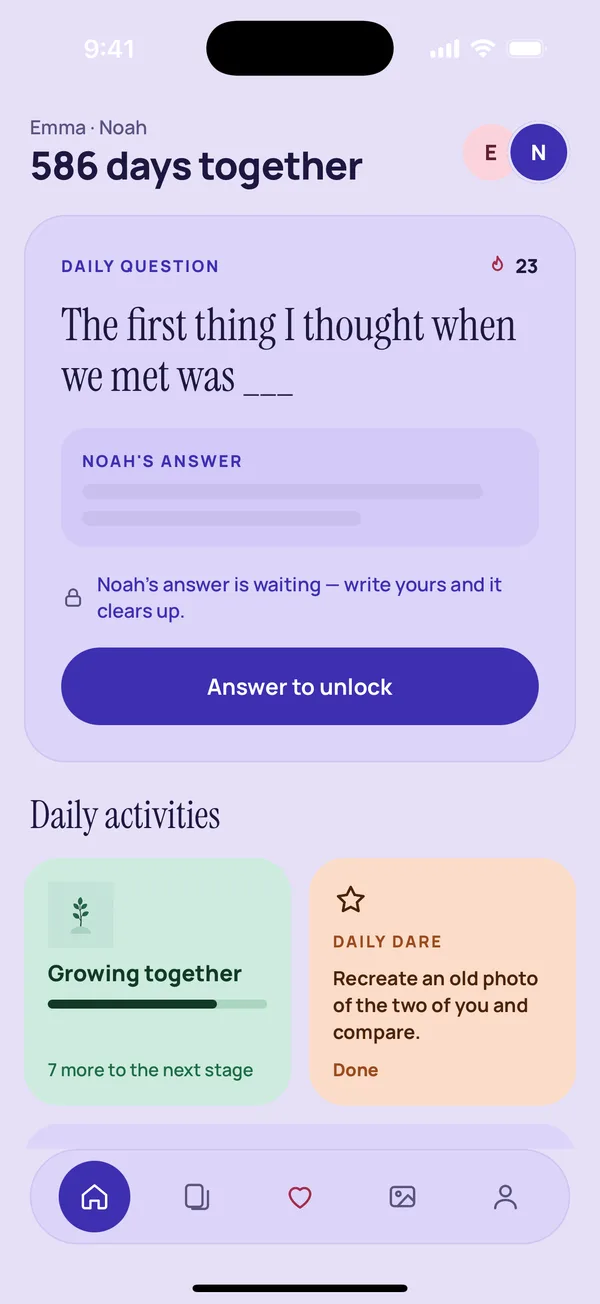
One question a day for you and your partner. Your answers stay hidden until you both reply.


Coming soon to iPhone and Android
Frequently asked questions
Are these questions based on psychology?
The format is inspired by published relationship research, listed on this page. The questions themselves are our own and are meant for fun and connection, not therapy.
Are the questions on the site the same as in the app?
No. The site lists are free and written separately. The Loveto app has its own question packs.
How often are the lists updated?
We review and extend the lists regularly. The date at the top of each page shows the latest update.